30 Years of Change: How Business, CRM, and Data Quality Have Evolved
When DQ Global was founded in 1995, “CRM” wasn’t yet the industry-defining term it is today. Customer records often lived in filing cabinets, on Rolodex cards, or if you were ahead of the curve, in an early desktop contact management system. Email was still a novelty, fax machines were essential, and business travel for face-to-face meetings was the norm.
Fast forward three decades and CRM platforms like Microsoft Dynamics 365 are the beating heart of customer engagement, integrating sales, marketing, and finance into a unified, AI ecosystem. We’ve been there through every step of that journey.
1990s: The Age of Static Records
In the 1990s, customer information was painstakingly entered by hand from paper forms into tools like ACT!, GoldMine, or the newly launched Siebel Systems. Departments typically kept their own records, creating silos that made it nearly impossible to get a single view of the customer. Duplicates were rife, and deduplication was a manual, time-consuming task.
It was during this decade that we launched our first deduplication product, helping customers match and clean their records without the painful export-and-import process.
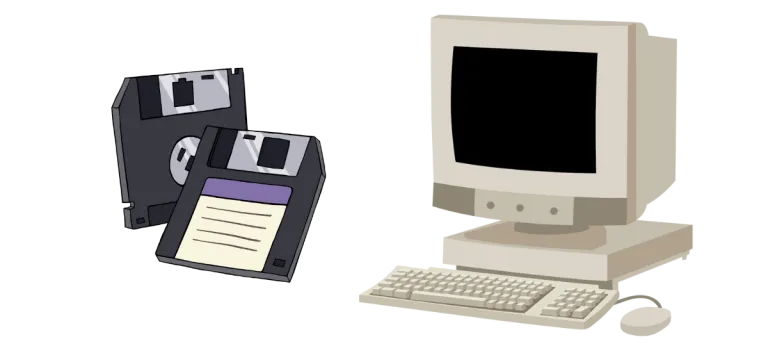
The technology of the 90s was desktop-bound. Software came on floppy disks or CDs, sometimes accompanied by thick printed manuals. The desk telephone was your lifeline, cold calling was an art form, and business cards (occasionally with a photo) were a key part of networking. Reporting was often built in Excel, or quite literally scribbled on a whiteboard.
2000s: The CRM Boom and the Cloud Revolution
The early 2000s saw CRM go mainstream. Salesforce pioneered cloud-based CRM, and Microsoft launched Microsoft CRM in 2003. Centralised databases began replacing siloed spreadsheets, making it easier to consolidate customer information. Though bulk importing sometimes just meant importing bulk bad data. The “garbage in, garbage out” problem became a recognised business challenge.
We expanded our integrations during this period, connecting our matching and cleansing tools to more CRM systems, so data quality could be addressed inside the very platforms where teams worked every day.
Meanwhile, the workplace was changing: broadband replaced dial-up, online collaboration tools began to appear, and email marketing was becoming more sophisticated. Cheques were still common for payments, but the move to electronic transfers was underway.

2010s: The Connected Era
By the 2010s, on-premises CRM was giving way to the cloud. Microsoft Dynamics 365 blended CRM and ERP capabilities, while APIs connected CRM to marketing automation, customer service, and ERP systems. Data began flowing from a array of sources, creating both opportunity and complexity.
With so much data coming from so many channels, inconsistencies and duplication across systems caused operational friction. This drove the adoption of Master Data Management (MDM) and advanced matching algorithms, something we embraced by launching new solutions that worked natively inside Dynamics CRM.
Work itself had also changed. Video conferencing was becoming commonplace, LinkedIn replaced the Rolodex, and “business casual” was replacing the universal suit and tie. Software manuals were replaced with searchable online help centres and, increasingly, YouTube tutorials.

2020s: AI-Driven, Real-Time Insights
In the 2020s, AI and machine learning has started becoming embedded in CRM. Tools like Microsoft’s Copilot deliver predictive insights and next-best-action recommendations. Cloud platforms now scale effortlessly to handle billions of customer interactions in real time, while data validation happens instantly at the point of entry. Automated fuzzy matching, phonetic cleansing, and cross-platform consolidation are routine.
In our own work, we’ve introduced on-demand data quality services and continued to evolve our tools to meet the real-time demands of modern CRM users.

Today’s work environment would be almost unrecognisable to the business world of 1995. Teams calls instead of in boardrooms, contracts are signed digitally, and even complex reports are built in live dashboards that update in real time. Yet the core principle that has driven us for 30 years remains the same: better data leads to better decisions.
As we celebrate three decades of helping organisations turn their customer data into a competitive advantage, we look forward to continuing that journey, whatever the future holds.